I Spent 3 Weeks Investigating Why My Foundation Goes Patchy By 3pm. The Answer Came From An Aquarium.
It started with a work selfie I almost cried over.
I'm a beauty writer. I've been paid to put product on my face for the better part of a decade. So when I tell you that on a perfectly ordinary Tuesday afternoon, I caught my reflection in an elevator mirror and genuinely flinched, you should understand: this is supposed to be the one thing I'm good at.
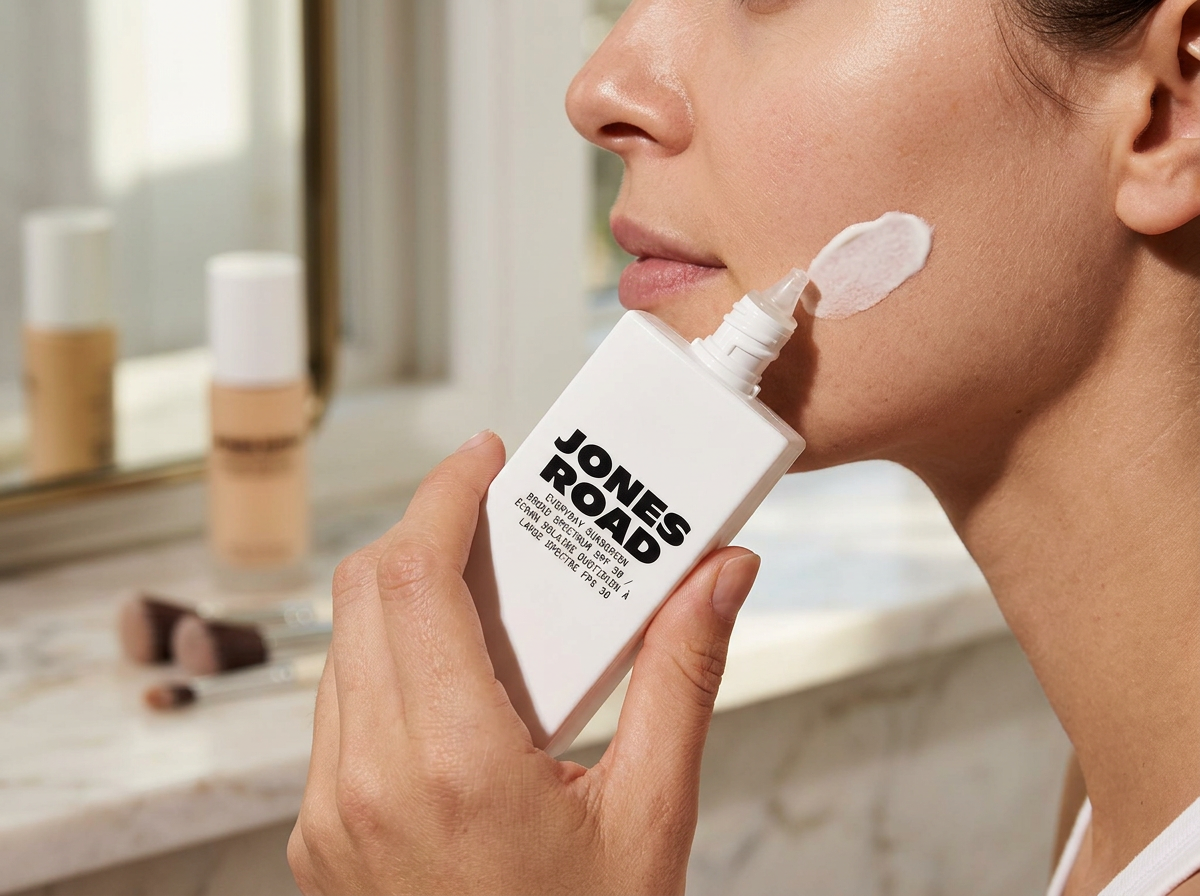
By 3pm, my foundation had separated into these strange little continents across my cheekbones. Patchy. Mottled. There was a weird gray cast around my nose. The skin underneath looked blotchy in a way it hadn't looked at 8am. And the worst part? I'd done everything "right."
In the three weeks leading up to that elevator moment, I had tested twelve foundations. Four primers. Three setting sprays. I tried the dewy ones. The matte ones. The "skin tints" everyone on TikTok swears by. I tried baking. I tried not baking. I tried applying with a sponge, a brush, my fingers, and at one point, a pure act of desperation involving a silicone blender I'd seen on Instagram.
Nothing held. Every single afternoon, the same patchy, oxidized, vaguely sad face stared back at me.
I was ready to give up and just accept that maybe my skin was the problem.
Then, around midnight on a Thursday, I fell down a research rabbit hole that ended somewhere I never expected: an aquarium full of zebrafish.
Keep reading - the discovery is at the bottom →The Discovery: Why Scientists Keep Studying These Tiny Striped Fish
Here's something I didn't know before this rabbit hole: zebrafish are one of the most-studied animals in skin pigmentation research on the planet.
The reason is almost funny. Zebrafish have melanocytes - the same pigment-producing cells humans have - sitting close to the surface of their transparent bodies. Researchers can literally watch, in real time, how those pigment cells respond to UV exposure. Multiple peer-reviewed studies have used zebrafish models to map how UV light triggers melanocyte activity, how pigment migrates, and how unevenly it can express across the skin.
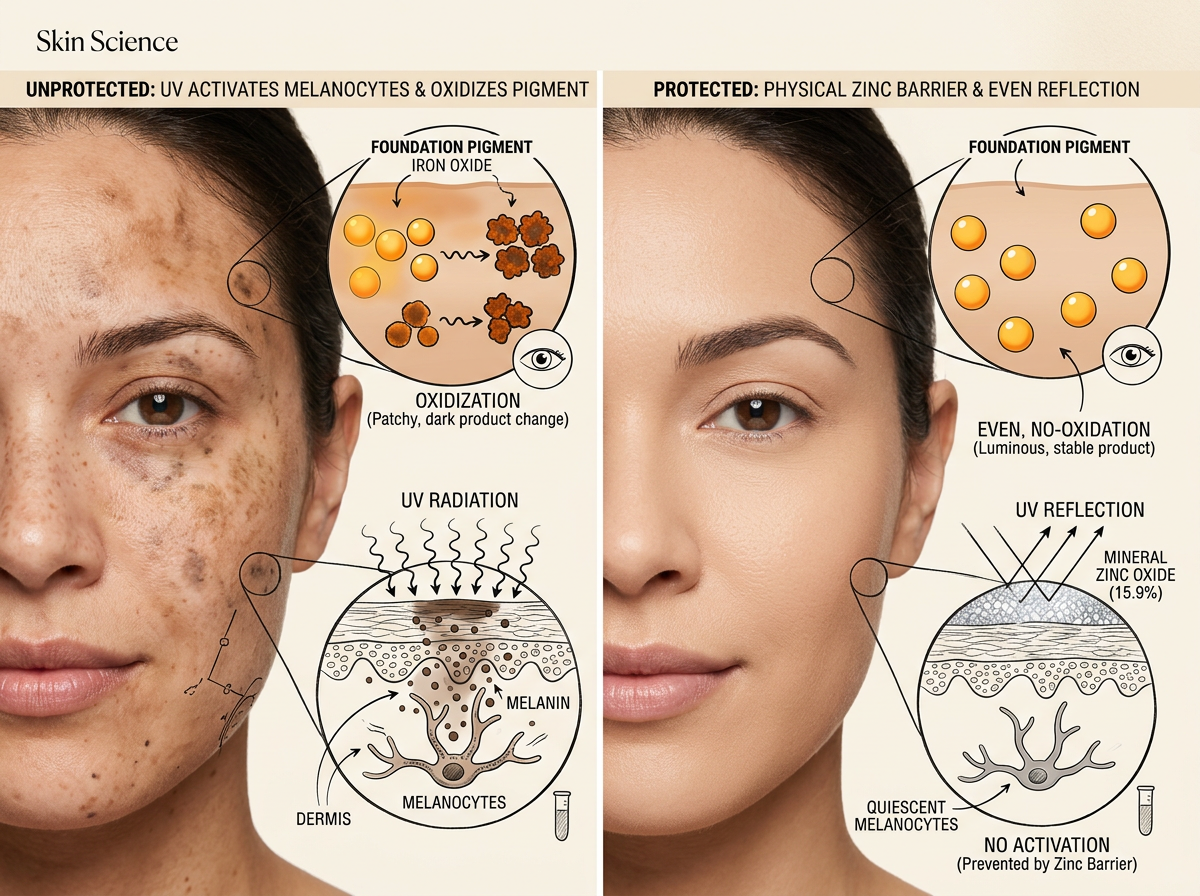
The relevant takeaway, in plain English:
When UV hits skin, melanocytes don't respond uniformly. Some areas fire harder than others. Some areas fire later than others. The response can be patchy, delayed, and surprisingly persistent - even from "casual" daylight exposure through a window or on a quick walk to lunch.
This is well-established science. Dermatology textbooks talk about it. It's why people develop melasma in irregular patches instead of a smooth tan. It's why the cheekbones, the upper lip, and the bridge of the nose tend to darken first - those are zones with naturally higher melanocyte density.
I sat there at midnight reading this and felt a little click in my brain.
Because where do my foundations always break down first?
Cheekbones. Upper lip. Bridge of the nose.
The exact zones the science kept circling.
I wasn't looking at a makeup problem. I was looking at a skin response problem - and my makeup was just the messenger telling me something was happening underneath it that I'd been completely ignoring.
That midnight realization is what started everything. I'll tell you what I changed in a moment.
The "Aha" Moment: It Was Never About The Foundation
This is the part that genuinely embarrassed me as a beauty writer.
For years, I'd been reviewing foundation through the lens of the foundation. Was the formula good? Was the finish nice? Did it set well? Did it have hyaluronic acid, niacinamide, the magical ingredient of the season?
I was asking the wrong question.
The right question turned out to be: what is happening between the foundation and the skin while I'm walking around all day?
Because here's what the research kept pointing to. Two things are happening simultaneously, and they're feeding each other:
One: UV exposure - even the casual kind that filters through your office window or hits you on a five-minute coffee run - is quietly stimulating uneven melanocyte response under your makeup. Your skin is shifting tone, slightly and patchily, while a layer of foundation sits on top.
Two: Most foundations are colored with iron oxides. Iron oxides are great pigments. They're also, chemically speaking, a form of iron that can oxidize over the course of the day, especially in the presence of UV, sebum, and heat. That's the technical reason your foundation looks "darker" or "orangey" or "dingy" by 3pm - it's literally a different shade than it was at 8am.
So you've got skin that's subtly changing color underneath, and foundation that's subtly changing color on top. They were never going to match by mid-afternoon. They couldn't.
The patchiness wasn't a foundation failure. It was a protection failure.
And once I saw it that way, I couldn't unsee it. The fix turned out to be the simplest thing in my routine.
Why Most Sunscreens Made It Worse (And Why I Stopped Wearing Them For Years)
Now, you might be reading this thinking, "Okay genius, just wear sunscreen."
I want you to know I tried. For years. And every attempt ended in disaster.
Here's the issue with most of what's on the market, and why I'd basically given up by the time the zebrafish thing happened:
Chemical sunscreens absorb UV. They don't block it. That's how the chemistry works - filters like avobenzone, oxybenzone, and octinoxate soak up UV rays and convert them into heat. The protection is real, but UV energy is still entering the skin. For someone with reactive melanocytes (which, per the research, is most of us), that absorption can still trigger some pigment response. I'd put on a high-SPF chemical sunscreen and still watch my upper lip darken by lunchtime.
Then there's the texture problem. I cannot tell you how many sunscreens I've put under foundation that immediately pilled - those little gummy rolls that show up the second you press a sponge to your cheek. Or worse, the chalky white cast. I have medium skin. I've walked out of the house looking like a ghost. I've watched friends with deeper skin tones get treated even worse by these formulas.
And the silicone-heavy "makeup-friendly" SPFs? They felt nice for the first hour. Then they slid. Then my foundation slid with them. By 3pm I was right back to patchy.
So I did what a lot of women do - I quietly stopped wearing sunscreen daily. I told myself I'd "be careful." I'd reach for it before the beach and skip it the rest of the time. Which, after my zebrafish education, I now understand was the worst possible choice for the exact problem I was trying to solve.
I needed something different. A physical barrier. No chemical absorption. No white cast. No pilling. Something that could actually live underneath foundation without staging a coup.
That's a tall order. I assumed it didn't exist.
Then a friend handed me a bottle and refused to take no for an answer.
The Solution: A Mineral Sunscreen That Doesn't Fight Your Makeup
The friend in question is a makeup artist. She does editorial work in New York. She does not have time for products that don't perform. She handed me a flat white pump bottle and said, "Wear this every day for two weeks before you write another word about foundation."
It was Jones Road Beauty's Everyday Sunscreen.
Here's why it actually solved the problem - and I'm going to be specific, because the specificity is the whole point.
It's a mineral sunscreen with 15.9% Zinc Oxide. That percentage matters. Zinc oxide is a physical UV blocker - it sits on top of the skin and reflects UV rays rather than absorbing them. It's broad spectrum SPF 30. It's the same active dermatologists tend to recommend for sensitive and reactive skin because it's far less likely to cause irritation than chemical filters.
It's formulated with color-correcting pigments to counter the white cast. This was the part that sold me. The single biggest reason mineral sunscreens have historically been a nightmare is that high-percentage zinc looks chalky on most skin tones. Jones Road built pigments directly into the formula to neutralize that cast. The result is a finish that, per their description, is "smooth, lightweight, and virtually undetectable on the skin."
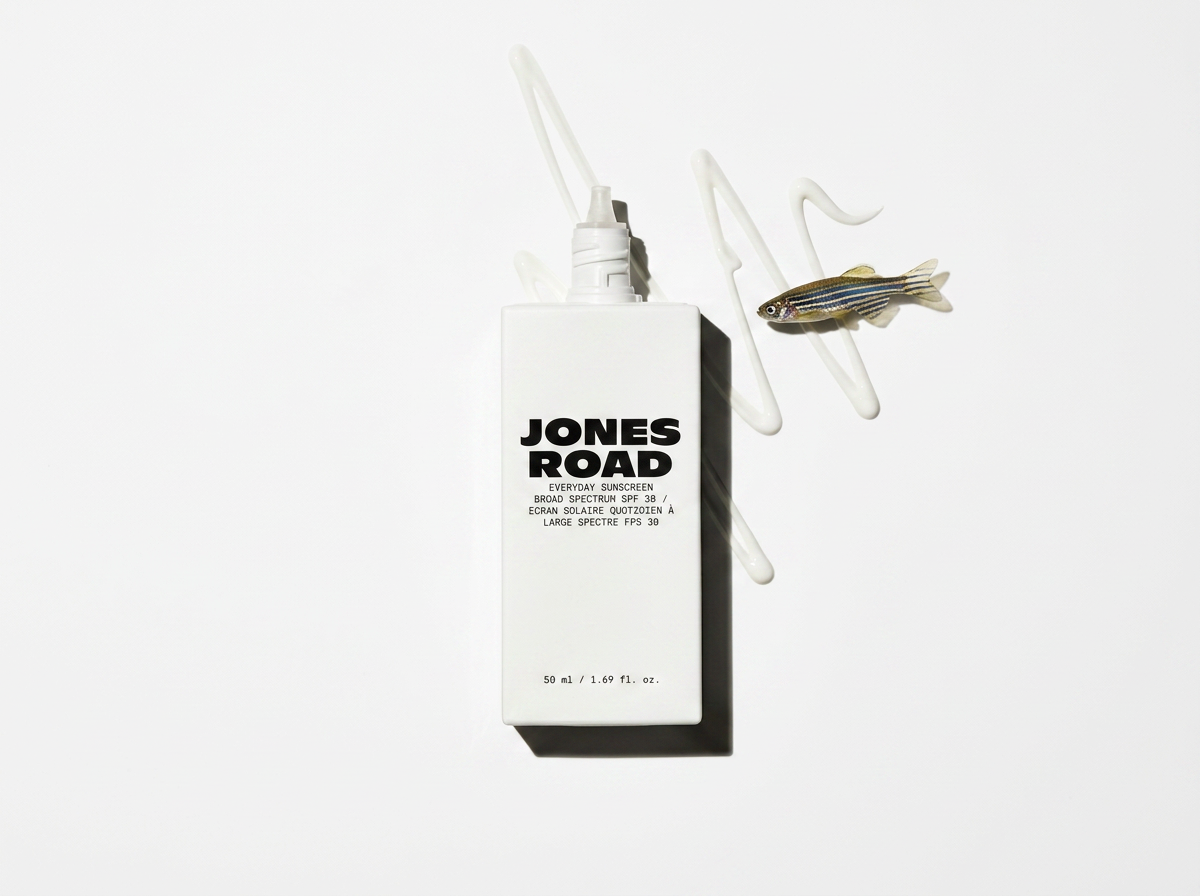
It plays nicely with makeup. The formula is designed to layer under foundation without pilling. That detail alone took it from "interesting product" to "the only sunscreen I'll use." Because what's the point of any of this if your base falls apart the moment you blend?
It's loaded with skin-friendly support ingredients. Argan Oil, Vitamin E (Tocopherol), and Bisabolol. None of which are doing the SPF work, but all of which keep the skin barrier happy through the day. It's also non-comedogenic, which matters if you're acne-prone.
I started using it as the last step before foundation. Just one pump, pressed in with my fingertips, ninety seconds to settle.
Did my face transform overnight? No. I want to be honest about that. Day one, I just had a perfectly normal day where my makeup looked roughly the same at 5pm as it did at 8am. Day three, I noticed my cheekbones weren't doing the patchy thing. Around the end of week two, I caught myself in an elevator mirror at 4pm and didn't flinch.
That was the moment. Not a transformation. A return to my face actually looking like itself all day.
I've used it every morning since. It's a small bottle that's quietly fixed something I'd been blaming on twelve different foundations.
The Proof: Why I'm Not The Only One
I'm aware that one beauty writer's elevator-mirror story is anecdote, not evidence. So let me give you the rest.

Jones Road's Everyday Sunscreen currently holds a 4.5 out of 5 star rating across 462 reviews. That's not a launch number. That's a sustained number, accumulated by real customers using it in real life.
The endorsement that means the most to me, though, comes from Bobbi Brown herself - the woman who effectively built the modern "no-makeup makeup" category and who founded Jones Road. Her quote on this product is exactly four words long:
"Just use it. Your skin will thank you." — Bobbi Brown
I love that quote because it's the opposite of how the beauty industry usually talks. No revolutionary claims. No miracle promises. Just a quiet, confident directive from someone who has spent her entire career formulating products that respect the face they're going on.
That's the entire ethos of the brand, actually. Clean Slate formulas - no phthalates, sulfates, parabens, PEGs, EDTA, or BPA. Designed to work with skin instead of bullying it into submission. The kind of products you can use every single day for years.
Which, for a daily sunscreen, is exactly the bar. If you're going to wear something on your face every morning, it should be something you trust.
What I'd Tell A Friend
If you've made it this far, you're probably wrestling with some version of the same problem I was. Foundation that won't behave. A 3pm face that doesn't match your 8am face. The sneaking suspicion that you're doing something wrong even though you're following every rule.
I want to gently suggest that you might not be the problem. Your makeup might not even be the problem.
The thing happening between your skin and your makeup, all day, every day - the UV exposure your melanocytes are quietly responding to, the iron oxides slowly oxidizing in the heat - that's the variable nobody talks about. And the fix isn't more foundation, or a different primer, or another setting spray.
The fix is a real, physical, mineral barrier that doesn't fight your face.
Jones Road Everyday Sunscreen is $42 for a 50ml bottle. It's broad spectrum SPF 30, 15.9% zinc oxide, color-corrected to skip the white cast, and built to layer under makeup without pilling. It's the only sunscreen I've found that genuinely does what it says it does.
If you've been ready to give up on your skin the way I was - try this first. Two weeks. One pump every morning before your makeup.
Your 3pm face will tell you if I'm right.
Everyday Sunscreen
Lightweight Broad Spectrum SPF 30 Mineral Sunscreen that works flawlessly under makeup.
See Everyday SunscreenThis article reflects the personal experience of the writer. Individual results vary. For sun protection guidance specific to your skin, consult a dermatologist.